


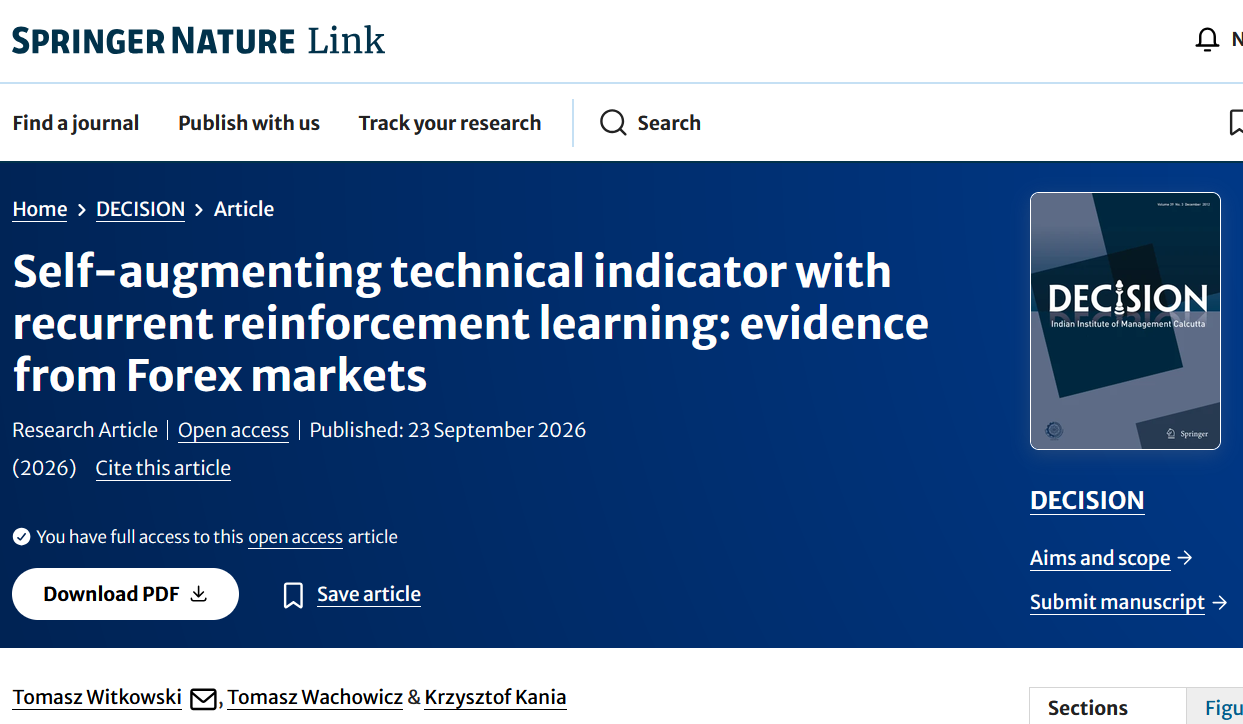
We are pleased to announce the publication of a new research article entitled “Self-augmenting technical indicator with recurrent reinforcement learning: evidence from Forex markets”, published in the journal Decision (Springer). The authors of the paper are researchers from the University of Economics in Katowice: Tomasz Witkowski, Prof. Tomasz Wachowicz, and Prof. Krzysztof Kania. The article addresses the efficiency of traditional technical analysis tools in the foreign exchange (Forex) market and explores how they can be augmented using artificial intelligence algorithms..
The article was published in open access and can be accessed by downloading the file directly from the publisher's website at: https://link.springer.com/article/10.1007/s40622-026-00479-x
Main Findings and Content Substantively, the study focuses on overcoming the limitations of traditional technical indicators (such as MACD), which generate trading signals solely based on current values or fixed thresholds. In practice, experienced traders analyze entire shapes and historical sequences on price charts. The authors investigated whether the short-term trajectory of an indicator contains hidden information that can consistently improve investment outcomes. Empirical tests conducted across eight major currency pairs demonstrated that incorporating indicator dynamics yields higher risk-adjusted returns (measured by the Sharpe ratio) compared to standard, optimized trading rules.
Methodological Approach Methodologically, the article presents a lightweight, minimalist model based on Recurrent Reinforcement Learning (RRL). Instead of relying on complex datasets and hundreds of features, the RRL agent receives only a sequence of the last 12 MACD indicator values, its current signal, and the current market position. Built on a two-layer neural network, the model directly optimizes the Sharpe ratio and decides whether to deviate from the baseline rule. The approach was subjected to rigorous out-of-sample robustness testing spanning the 2022–2025 period (including events such as the war in Ukraine and monetary policy tightening cycles), confirming its effectiveness under changing market conditions.
